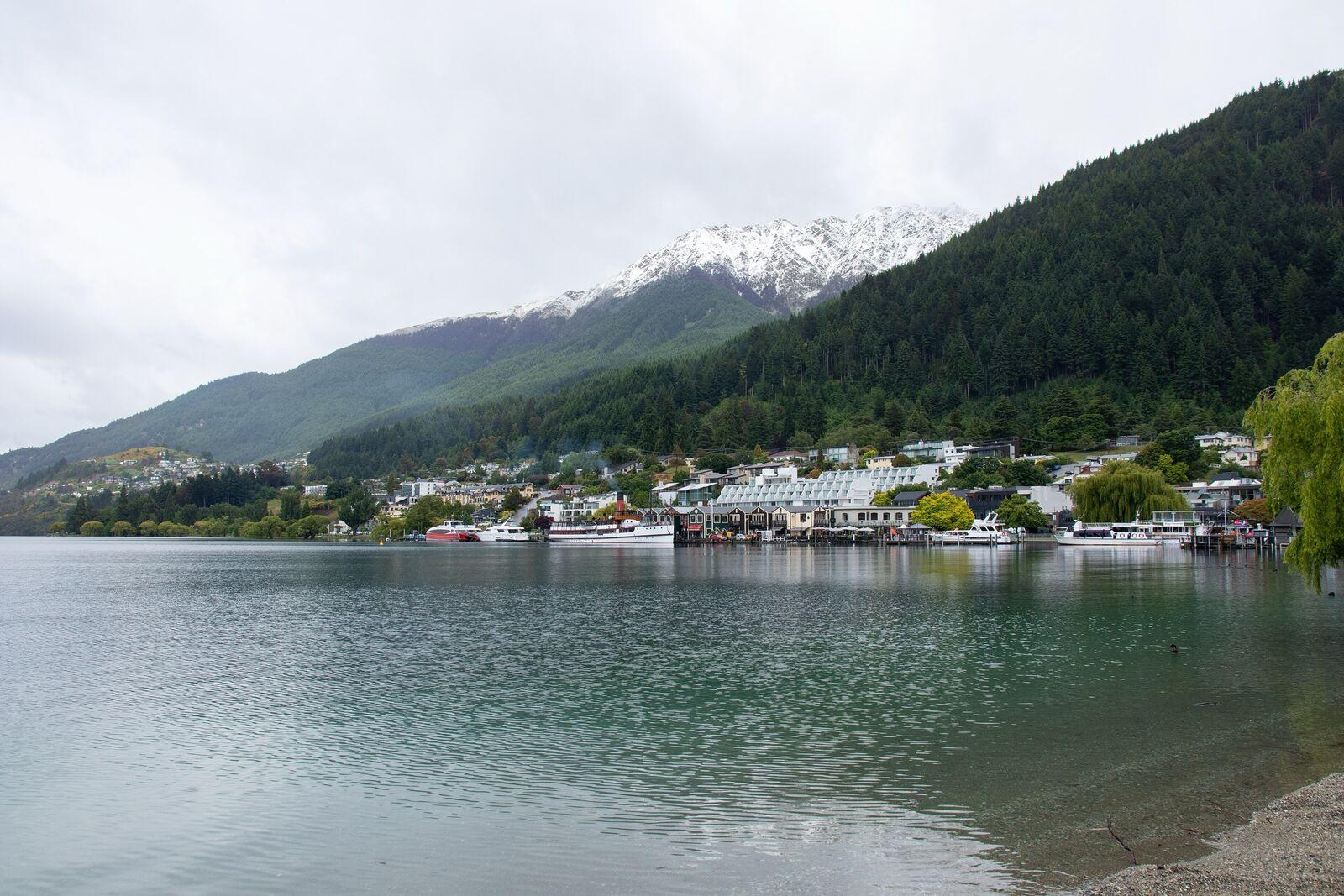
Photo: Σ64 (opens in a new tab), CC BY 4.0 (opens in a new tab)
Best time to visit Queenstown: the weather, month by month
Checked 12 Oct 2026Published 4 Sept 2026
In short
For warm weather and fewer people, March; for snow, August; for the cheapest quiet, May. Queenstown’s mean temperature runs from 3.4 C in July to 15.9 C in January, rain is an even 49 to 75 mm every month (721 mm a year), and sunshine swings from 69 hours in June to 237 in January.
Take this page with you
This page, the offline map and every Orbus bus time on your phone.
 On a laptop?
Scan with your phone.
- January mean, the warmest
- 15.9 C
- July mean, the coldest
- 3.4 C
- January sunshine hours
- 237 h
- Rain a year, spread evenly
- 721 mm
- Summer peak occupancy, or more
- 89%
- Daylight, 22 December 2026
- 15 h 37 min
From this guide’s sources, listed at the foot of the page.
About this guide
Not a feelings piece. NIWA's thirty-year averages for temperature, rain and sunshine, month by month, with what is open and what it costs in each season.
By Queenstown Pocket · Corrected 26 September 2026 · Photograph: Queenstown's waterfront across the bay, with snow on the tops, December 2019 (all photo credits)
Month by month, from NIWA’s normals
Queenstown through the year
Mean temperature, C
Rainfall, mm
Sunshine, hours
| Month | Mean temp (C) | Rain (mm) | Sunshine (h) | What it is like |
|---|---|---|---|---|
| January | Mean temp (C): 15.9 | Rain (mm): 72 | Sunshine (h): 237 | What it is like: Summer peak. Long days, the lake is swimmable, everything open, prices highest. |
| February | Mean temp (C): 15.6 | Rain (mm): 51 | Sunshine (h): 209 | What it is like: The most settled month on the normals, second only to March for rain. Still peak season. |
| March | Mean temp (C): 13.2 | Rain (mm): 49 | Sunshine (h): 180 | What it is like: Warm days, cooler nights, crowds thin after the first week. Locals' favourite. |
| April | Mean temp (C): 9.8 | Rain (mm): 58 | Sunshine (h): 136 | What it is like: Autumn colour in Arrowtown (the 2027 festival is 15 to 18 April). Ski fields closed. |
| May | Mean temp (C): 7.1 | Rain (mm): 75 | Sunshine (h): 84 | What it is like: The wettest month on average and the quietest. Early snow on the tops. |
| June | Mean temp (C): 4.1 | Rain (mm): 62 | Sunshine (h): 69 | What it is like: Ski season opens mid to late June. Shortest days, least sunshine. |
| July | Mean temp (C): 3.4 | Rain (mm): 56 | Sunshine (h): 85 | What it is like: Coldest month. Peak ski season and the July school holidays; book everything. |
| August | Mean temp (C): 5.2 | Rain (mm): 53 | Sunshine (h): 120 | What it is like: Best snow on average; the mountains stay busy, town is quieter. |
| September | Mean temp (C): 7.7 | Rain (mm): 62 | Sunshine (h): 151 | What it is like: Spring skiing and spring lift prices; blossom in town, snow on the hill. |
| October | Mean temp (C): 9.9 | Rain (mm): 62 | Sunshine (h): 197 | What it is like: Ski fields close early to mid October. Trails reopen, prices dip. |
| November | Mean temp (C): 11.9 | Rain (mm): 61 | Sunshine (h): 218 | What it is like: Marathon weekend (14 November 2026), long evenings, before the Christmas rush. |
| December | Mean temp (C): 14.3 | Rain (mm): 60 | Sunshine (h): 213 | What it is like: Summer arrives; Christmas to New Year is the busiest fortnight of the year. |
The figures are the 1991 to 2020 climate normals for the Queenstown station published by NIWA (Earth Sciences New Zealand): mean monthly air temperature, mean monthly rainfall and mean monthly bright sunshine. Means hide the swing: a January afternoon is often 25 C or more, and a clear July night drops well below zero.
The four seasons, honestly
- Summer (December to February). Warmest and sunniest, 15 to 16 C mean, over 200 sunshine hours a month, and the busiest, dearest fortnight of the year at Christmas. Everything is open; book accommodation and Milford well ahead.
- Autumn (March to May). The local secret. March is as dry as any month and still 13 C; April brings the Arrowtown colour; May is the wettest month on average (75 mm) and the quietest in town, with the ski fields not yet open.
- Winter (June to August). Cold, short days (69 sunshine hours in June), and the ski season that fills the town in July. Snow rarely settles in town; it sits on the mountains. Chains and the ski bus matter; see the ski fields guide. For the daily highs and lows, frost and snow, see Queenstown weather in July.
- Spring (September to November). Sunshine climbs from 151 hours in September to 218 in November, spring lift prices run from 1 September, trails reopen as the snow line lifts, and November has the Marathon on the 14th in 2026.
Daylight, and why it matters
Queenstown sits at 45 degrees south, so the day length swings hard. On the December solstice, 22 December 2026, the sun rises at 5:55am and sets at 9:32pm, 15 hours 37 minutes of daylight; on the June solstice, 22 June 2027, it rises at 8:24am and sets at 5:10pm, 8 hours 46 minutes. Those are our own figures from NOAA’s solar equations for the town centre on a level horizon, the method behind the daylight dial on the month guides; the ranges round the lake hide the sun earlier. Summer evenings are why the town eats late; winter afternoons are why the ski bus starts heading down at 1pm.
Questions people ask
What is the best month to visit Queenstown?
For warm, settled weather with fewer people, March: a mean of 13.2 C, 49 mm of rain (the driest month on NIWA's normals with February) and 180 sunshine hours. For skiing, August has the best snow on average. February is the driest summer month; January is the sunniest.
What is the weather like in Queenstown in November?
Mild and lengthening: a mean temperature of 11.9 C, about 61 mm of rain over the month and 218 sunshine hours on the 1991 to 2020 normals. Daylight runs past 8:30pm by late November, the ski fields have closed and the walking tracks are open.
What is the coldest month in Queenstown?
July, with a mean temperature of 3.4 C on NIWA's 1991 to 2020 normals. June is nearly as cold (4.1 C) and has the fewest sunshine hours of the year at 69.
How much does it rain in Queenstown?
About 721 mm a year, spread remarkably evenly: every month averages between 49 mm (March) and 75 mm (May). Rain here tends to come in fronts that pass, not in wet seasons.
When is ski season in Queenstown?
Mid to late June until early to mid October, snow permitting. In 2026 Coronet Peak ran 13 June to 4 October and The Remarkables 27 June to 11 October; Cardrona ran to 18 October. August is the best snow month on average.
When is Queenstown busiest?
Christmas to New Year, the July school holidays and, for events, Marathon weekend in mid November. Commercial accommodation runs at 89 percent or more in the summer peak. May and early June are the quietest.
Get the app
Queenstown Pocket carries the 7-day forecast, the snow reports and what is open today, offline.
Related guides
- Getting around
Queenstown bus routes & fares
All six Orbus routes, the $2.50 airport bus, Bee Card vs cash fares and the ferry.Checked 13 Nov 2026  Getting around
Queenstown Airport to town: bus, taxi, shuttle or rental
The $2.50 bus, what a taxi costs, shuttles, and when a rental car makes sense.Checked 13 Nov 2026 Getting around
Do you need a car in Queenstown?
Where the bus gets you, where it does not, and what a car, shuttle or tour costs instead.Checked 26 Sep 2026 Planning
Free things to do in Queenstown
Twelve free things, and the $2.50 bus that gets you to each one.Checked 5 Nov 2026
Photographs are credited on each guide and on the photo credits page.
Sources: Destination Queenstown, Monthly Data Snapshot (commercial accommodation occupancy), NIWA, mean monthly temperatures 1991 to 2020 (opens in a new tab), NIWA, mean monthly rainfall 1991 to 2020 (opens in a new tab), NIWA, mean monthly sunshine hours 1991 to 2020 (opens in a new tab), NOAA Global Monitoring Laboratory, General Solar Position Calculations (sunrise, sunset and day length, our computation) (opens in a new tab) and US Naval Observatory, Earth's Seasons data service (solstice dates, 2026 and 2027 in New Zealand time) (opens in a new tab), retrieved 26 September 2026. Rainfall figures are rounded to the nearest millimetre and sunshine to the nearest hour; season dates and event dates are the 2026 published figures. This independent guide is published by Tally Sphere Limited, a New Zealand company. Spotted a change? Report a problem with this page and the page address comes with your email.